
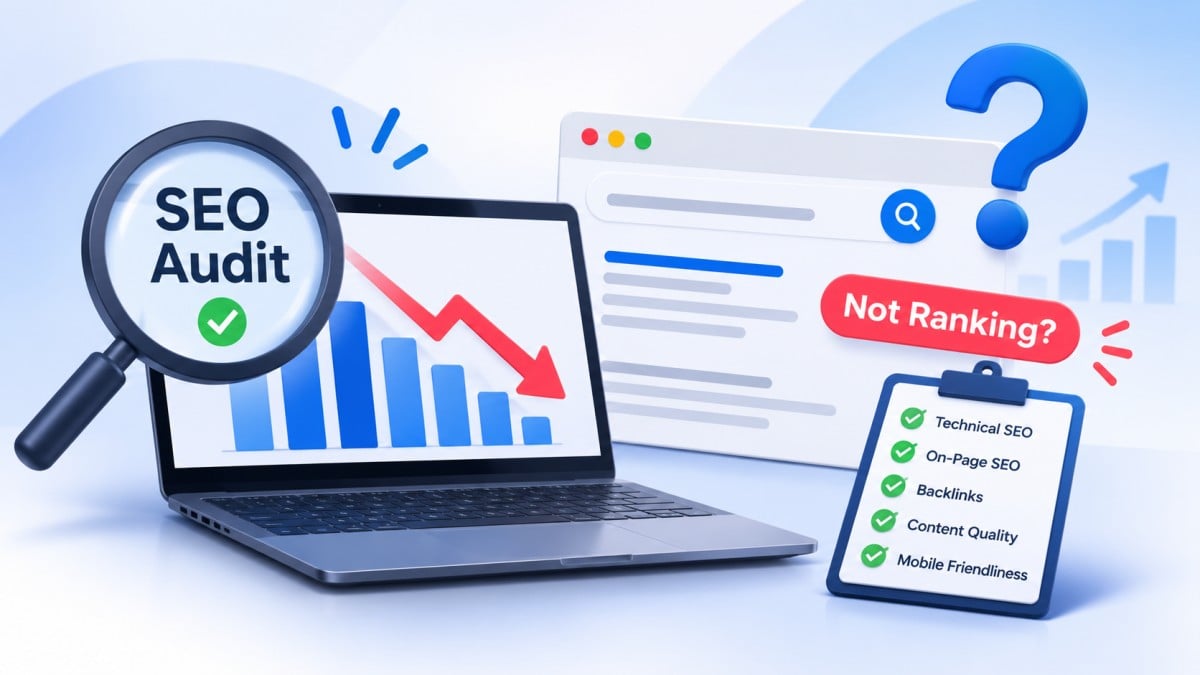
Having a website doesn’t guarantee that it will appear on the first page of Google. If your website is not getting enough organic traffic or your pages are struggling to rank in search results, several SEO issues could be responsible. These may include technical errors, poor content quality, slow page speed, weak backlinks, or incorrect keyword targeting.
Understanding these problems is the first step toward improving your website ranking. A comprehensive SEO Audit can help identify the issues affecting your search visibility and provide a clear direction for optimization.
1. Your Website Has Technical SEO Issues
Technical SEO helps search engines crawl, understand, and index your website correctly. If Google cannot access or index your pages, they may not appear in search results, regardless of how useful your content is.
Common technical SEO problems include:
- Broken internal links and 404 errors
- Missing or incorrect XML sitemaps
- Incorrect robots.txt directives
- Pages blocked from indexing
- Duplicate URLs and canonicalization issues
- Missing or improperly configured HTTPS
Regularly checking these elements can help you identify technical problems before they negatively affect your SEO ranking. Use a website SEO checker to review important on-page and technical SEO elements and determine which issues need attention.
2. Your Content Does Not Match Search Intent
Google aims to provide users with relevant answers to their searches. If your content does not address what users are looking for, your pages may struggle to achieve better rankings.
For example, someone searching for “how to improve website speed” probably wants practical instructions rather than a general explanation of website performance.
To improve content relevance:
- Understand the search intent behind your target keywords.
- Answer the main question early in the content.
- Include relevant secondary and long-tail keywords naturally.
- Provide accurate, helpful, and original information.
- Update outdated information when necessary.
Avoid adding keywords simply to increase their frequency. Focus on creating content that satisfies users’ needs and provides information that is genuinely useful.
3. Your Website Has On-Page SEO Problems
On-page SEO helps search engines understand the subject and relevance of individual pages. Missing or poorly optimized elements can make it harder for search engines and users to understand your content.
Some common on-page SEO issues include:
- Missing or duplicate title tags
- Poorly written meta descriptions
- Incorrect heading structure
- Missing image alt text
- Weak internal linking
- Unclear page content and keyword targeting
Conducting an SEO Audit helps you review these elements and identify opportunities for improvement.
Write unique title tags and meta descriptions for important pages, organize content with descriptive headings, and link related pages together. These improvements can strengthen your website’s relevance and make pages easier to navigate.
4. Your Website Loads Slowly
Website performance can influence both user experience and search visibility. Visitors may leave if pages take too long to load, particularly on mobile devices.
Slow-loading pages may result from oversized images, unnecessary JavaScript, excessive third-party scripts, or inefficient server responses.
To improve page performance:
- Compress and properly size images.
- Reduce unnecessary JavaScript and CSS.
- Enable browser caching where appropriate.
- Improve server response times.
- Optimize mobile usability.
- Monitor Core Web Vitals.
Use performance testing tools to identify the specific issues affecting your pages. Improving loading speed can create a smoother user experience and help support your broader SEO strategy.
5. Your Website Has Weak Backlinks
Backlinks are links from other websites pointing to your pages. Relevant, trustworthy backlinks can help search engines discover content and evaluate its authority.
If competing websites have stronger backlink profiles, they may have an advantage for certain competitive search queries.
However, building backlinks is not simply about increasing their number. Focus on earning links through useful content, industry contributions, digital PR, and genuine relationships with relevant websites.
Avoid buying large quantities of low-quality links or using manipulative link-building schemes. A sustainable backlink strategy prioritizes relevance, quality, and natural link acquisition.
6. Your Website Is Targeting the Wrong Keywords
Choosing keywords without understanding their relevance or competition can make it difficult to achieve meaningful website ranking improvements.
For example, a new website may struggle to rank for broad, highly competitive terms while overlooking more specific searches that closely match its services.
Improve your keyword strategy by:
- Researching relevant search terms.
- Evaluating search intent and keyword difficulty.
- Identifying long-tail keyword opportunities.
- Reviewing competitor content.
- Mapping primary keywords to appropriate pages.
- Checking for keyword cannibalization.
Keyword cannibalization occurs when multiple pages target similar search queries and compete with one another. Reviewing these pages can help you determine whether their content should be differentiated, consolidated, or better organized.
7. Your Website Is Not Mobile-Friendly
A website that works well on desktop but performs poorly on mobile can create a frustrating experience for visitors. Difficult navigation, unreadable text, intrusive pop-ups, and poorly sized buttons can discourage users from engaging with your content.
Google primarily uses the mobile version of a website’s content for indexing, making mobile accessibility and content consistency important.
Check whether your website uses responsive layouts, displays readable text, loads efficiently, and provides easy navigation across different screen sizes.
A mobile-friendly website helps visitors access information more comfortably and supports a stronger overall SEO foundation.
8. You Are Not Monitoring SEO Performance
SEO improvements require consistent monitoring. Without reviewing performance data, it can be difficult to understand why rankings have changed or which pages need attention.
Monitor important metrics such as:
- Organic clicks and impressions
- Search queries and average positions
- Indexed and non-indexed pages
- Organic traffic trends
- Click-through rates
- Technical SEO errors
- Backlink growth
Google Search Console can help you understand how your website performs in Google Search. Combining performance data with regular SEO audits helps you prioritize problems based on their potential impact.
Remember that rankings can fluctuate because of competition, search algorithm updates, changing search intent, and other factors. Not every ranking decline indicates a technical problem.
How Can an SEO Audit Help Improve Your Website Ranking?
An SEO Audit provides a structured way to evaluate your website’s search optimization. Instead of guessing why pages are not ranking, you can investigate technical errors, on-page SEO problems, content gaps, internal linking, and other potential weaknesses.
Start by identifying your highest-priority pages and checking whether they are accessible, indexable, relevant to their target keywords, and useful to visitors.
Next, prioritize fixes based on their importance. Resolving indexing problems may be more urgent than rewriting a minor meta description, while improving content quality may be more valuable than making unnecessary technical changes.
A website SEO checker can simplify this process by helping you review important website elements and identify optimization opportunities. However, automated checks should be combined with performance data and human evaluation to understand the underlying causes of ranking problems.
Conclusion
If your website is not ranking, the problem may involve technical SEO, content relevance, keyword targeting, page speed, backlinks, or mobile usability. Identifying the actual cause is more effective than making random changes in the hope of improving search results.
Regular SEO audits, useful content, targeted keyword research, and ongoing performance monitoring can help you build a stronger search presence over time.
Elvisto helps website owners analyze website SEO issues, review optimization opportunities, and generate actionable audit reports. By using a website SEO checker to identify potential problems, you can make more informed decisions about improving your website’s SEO health and long-term search visibility.