
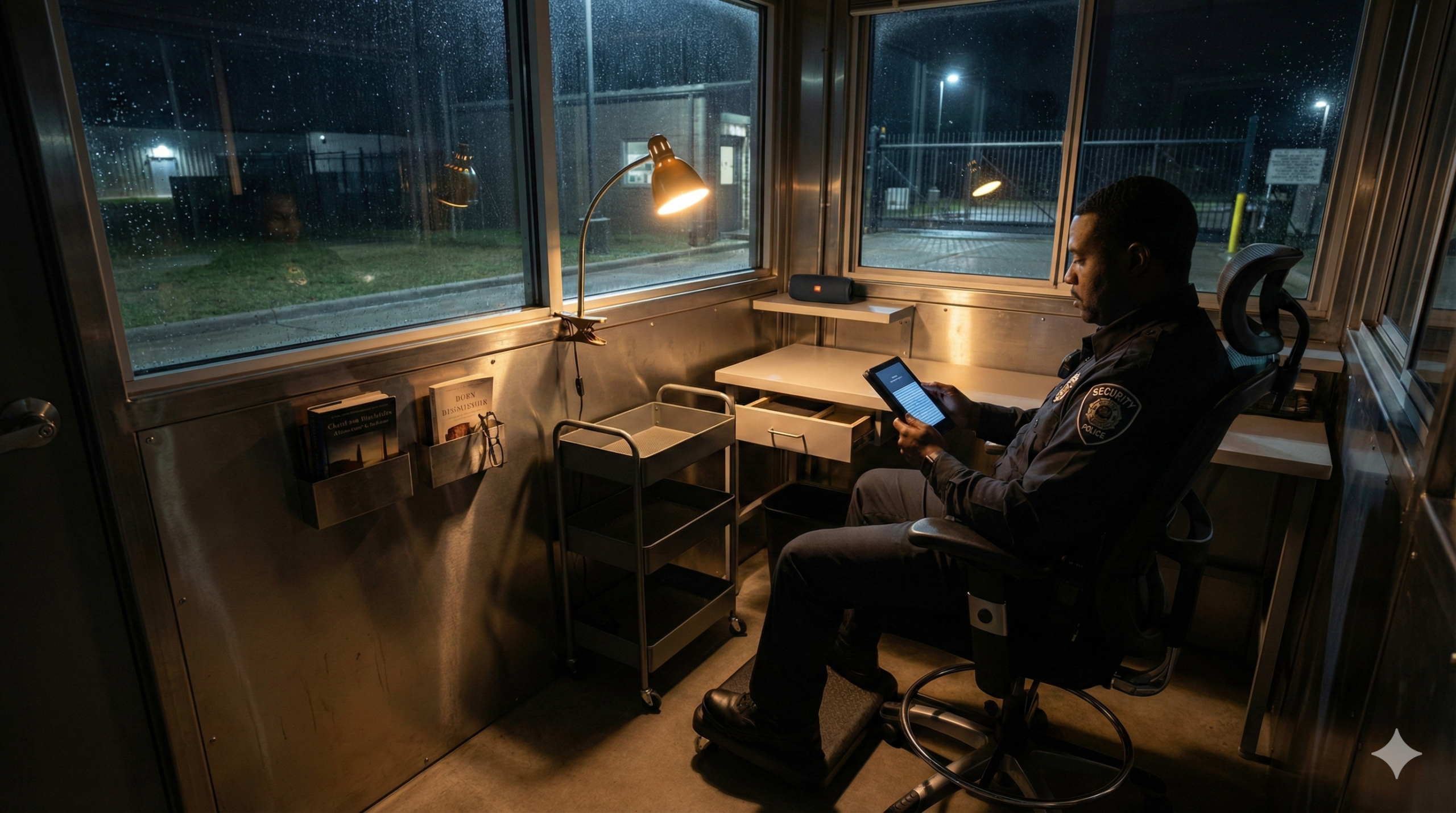
Ask any security professional about the hardest part of the job, and they usually won’t say it’s the confrontation or the risk. It’s the silence. It’s the 3:00 AM struggle to keep your eyes open when the facility is empty, the gate is closed, and the only thing moving is the second hand on the clock.
In the security world, mental fatigue is a genuine threat. A guard who has zoned out after staring at a gray parking lot for eight hours is a guard who might miss a breach. This is why many site supervisors are warming up to the idea of allowing reading during downtime. Unlike scrolling through a smartphone—which emits blue light that ruins night vision and looks unprofessional to passing clients—reading a book keeps the mind active and alert without the checked-out appearance of a phone zombie.
The logistical challenge, however, is real estate. A standard, prefabricated guard booth is designed for efficiency, visibility, and weather protection. It is not designed to be a library. These structures are compact by nature, prioritizing sightlines over creature comforts.
But compact doesn’t have to mean uncomfortable. With a few intentional adjustments, you can create a dedicated reading space that respects the constraints of the booth while keeping the officer’s mind sharp. Here is how to build a reader’s sanctuary without compromising security protocols.
1. Prioritize Lighting
Lighting is the trickiest variable in a security booth. At night, the interior needs to remain relatively dark so the guard can see out through the glass. If you turn on a bright overhead dome light to read, two things happen: you ruin your natural night vision, and you turn the windows into mirrors, making it impossible to see approaching vehicles. To create a reading nook, you need directional, contained light.
The Fix: Skip the ceiling light and invest in a high-quality, gooseneck clamp lamp or a rechargeable book light.
- Positioning: Clamp the light below the window line, aiming it strictly at the desk surface or the book itself.
- Color Temperature: Opt for warm or amber light settings if possible. Harsh blue-white LEDs are jarring at night and can leave tracers in your vision when you look up to scan the perimeter.
- The Blackout Check: Before settling in, step outside the booth. If the reading light illuminates the guard’s face clearly, it’s too bright. The goal is to illuminate the text, not the officer.
2. Create Vertical Storage Solutions
In a 4×6 or 6×8 booth, desk space is premium territory. That surface needs to remain clear for logbooks, badge scanners, phone systems, and monitors. If a guard dumps a stack of hardcovers on the counter, it creates clutter that can interfere with the workflow during a rush. Since you can’t build out, you have to build up (or down).
The Fix: Utilize the often-ignored wall space.
- Magnetic Organizers: Many modern guard booths are constructed with steel walls. Heavy-duty magnetic spice racks or file organizers are perfect for holding a current book, a bookmark, and reading glasses. No drilling required.
- The Under-Desk Zone: If the booth has an open space beneath the counter, a small, slim rolling cart can slide in between the file cabinet and the wall. This keeps personal items completely out of sight from the window but easily accessible during a lull in traffic.
3. Make a Specific Zone
Creating a reading area isn’t just about where you read; it’s about how fast you can stop reading. Security is a reactionary job. When a truck pulls up or an alarm triggers, the transition from reader to officer needs to be instant. If a guard is fumbling to close a book, find a bookmark, and shove it aside, it looks sloppy.
The Fix: Designate a specific zone. This should be a clean, empty spot on the desk or a specific drawer that is always left open a crack. The rule of the reading nook is simple: The book has a home, and that home is not “open on the desk.” Train yourself to use a magnetic bookmark that snaps in place instantly, allowing you to slide the book into its designated drawer in one smooth motion as headlights approach.
4. Use Audiobooks as an Alternative
Sometimes, the physical layout of a booth or the intensity of the traffic flow just doesn’t permit a physical book. If a guard needs to keep their eyes on a bank of CCTV monitors constantly, looking down at a page is a safety violation. This is where the reading area becomes digital.
The Fix: A Bluetooth speaker or a single-earbud policy. Many sites allow a small Bluetooth speaker at low volume. This transforms the entire booth into an audiobook listening station. It allows the guard to read a thriller or a biography while keeping their eyes 100% focused on the perimeter and the monitors. If using headphones, the golden rule is “one ear only.” You must always retain situational awareness of the ambient noise outside the booth—the sound of an idling engine, footsteps, or a gate latch clicking.
5. Focus on Ergonomics
It is tempting to try to squeeze a recliner or a bean bag into the corner to make the reading nook cozy. Resist this urge. A guard booth is a workspace, not a lounge. If the seating is too comfortable, the reading area quickly becomes a sleeping area.
The Fix: Stick to a high-quality, 24-hour rated office chair, but add lumbar support. To make reading comfortable without inducing sleep, focus on posture. A simple footrest under the desk can make a massive difference in comfort during a 12-hour shift. It allows you to lean back slightly with a book while keeping your spine aligned. Keep the environment alert and comfortable, meaning the temperature is cool, and the seating is upright.
6. Choose Between E-Readers vs. Paperbacks
Finally, consider the medium. In a small booth, a stack of magazines or heavy hardcover books adds visual clutter.
The Fix: An e-reader is often superior for booth work for two reasons:
- Backlighting: You can turn the device’s brightness down to 1% or use “dark mode” (white text on black background), which eliminates the need for an external lamp and preserves night vision.
- Optics: To a manager driving by, a guard holding a phone looks like they are texting or playing games. An e-reader looks distinctively different. It signals that the guard is engaging their brain, not their social media feed.
A guard booth is a unique ecosystem. It is a lonely, confined space that plays a critical role in safety. By curating a small, organized, and lighting-conscious reading area, you aren’t distracting from the job—you are enhancing the person doing it. A guard who is mentally engaged in a story is awake, alert, and ready to respond, which is exactly who you want watching the gate when the sun goes down.